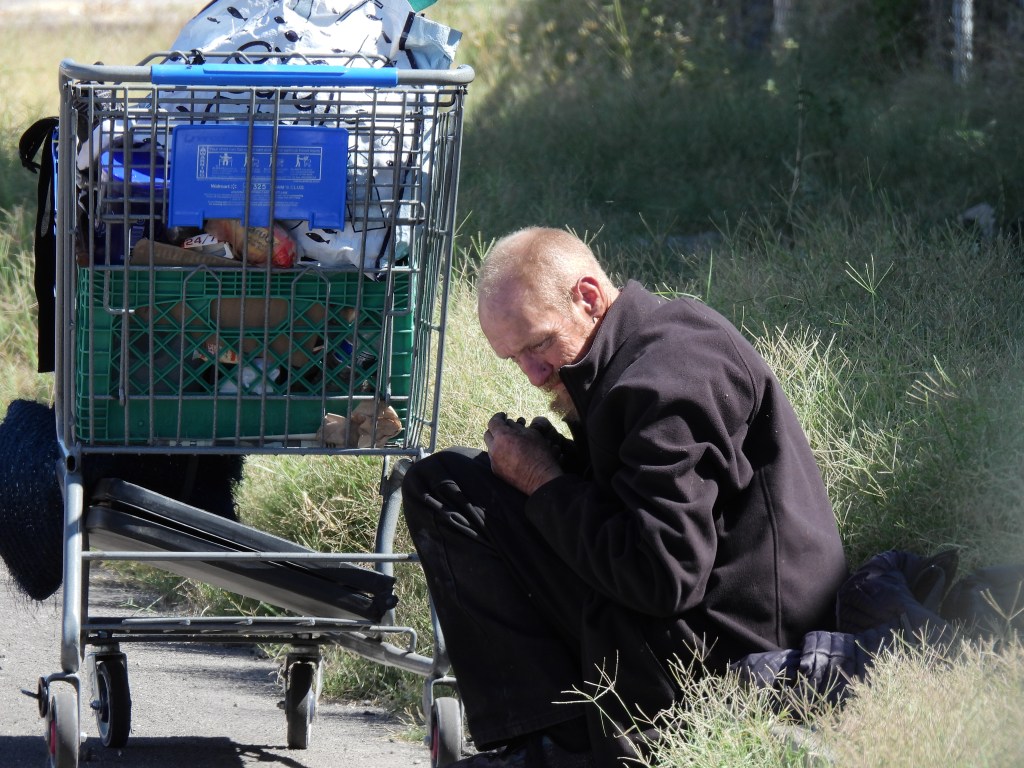
Leonard walked free from prison in 2018 and immediately became a prisoner on South Tucson’s streets. Upon completion of his five-month sentence in an Arizona state prison, he was to begin work as a wastewater treatment specialist.
However, Leonard could not be employed, as he was without ID, address, or phone. With no home, he took to the streets. Grizzled and slightly stooped, the 55-year-old Chicago native tells me he has been trying to get housing since his release.
“I’ve been on some kind of list, and I need to reapply every 90 days,” he says in a quiet, nasally voice. “I tell those people where I’m at, but they never come out, and I don’t have a phone. So, how can they contact me? I just put my name on the list again, and that’s what I’ve been doing since 2018. You would think I’d be put at the head of the list, but I go back to the end.”
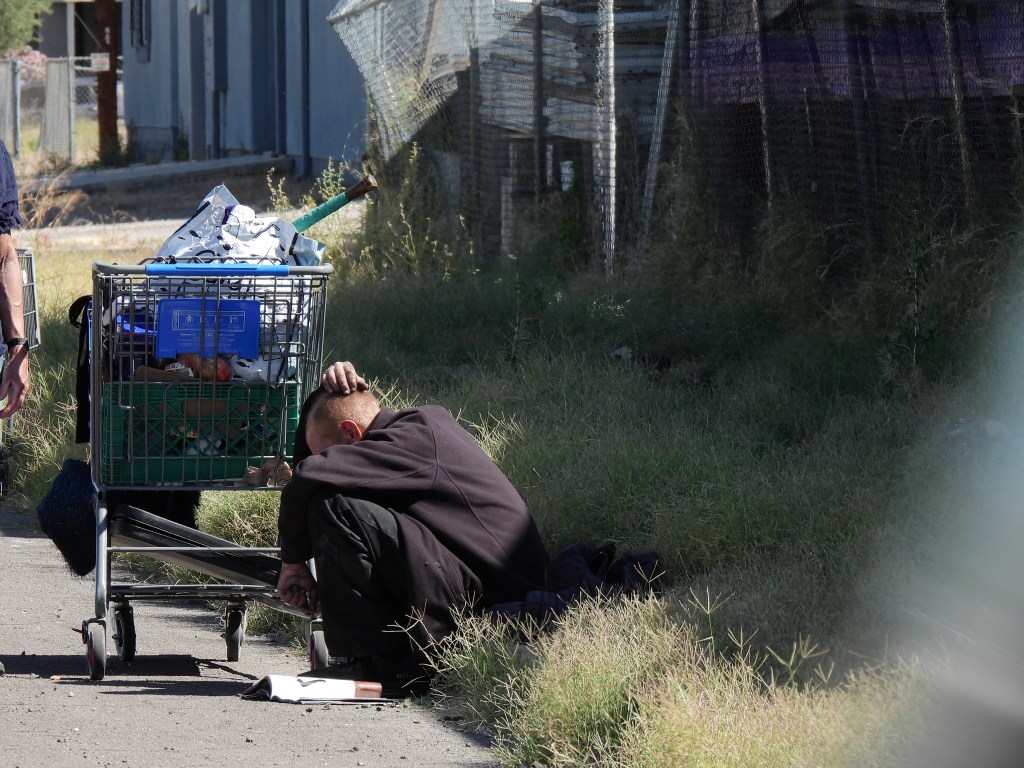
Leonard, clad in scruffy jeans and a T-shirt, says he survives on what he makes from working odd jobs and food stamps. It’s just enough to keep himself fed. The constant companion of today’s homeless—a grocery shopping cart—is at Leonard’s side, stuffed with plastic bags.
He declines to say what crime led to his imprisonment. Leonard, however, is emphatic that his time in jail upended his life. A Tucson resident since 1977, Leonard tells me he had a home and a job before imprisonment but “lost it all” while serving time.
“They’re supposed to hand you an ID right as you walk out of prison, but they never did. Without that, I couldn’t be hired. I couldn’t escape homelessness.” Leonard speaks wistfully about his former job, recalling he was a highly skilled wastewater management specialist.
He is similarly wistful and slightly discouraged about his prospects for a better life. “You know, there are people from other countries looking for asylum,” says Leonard. “They get hotel rooms and everything.
I’m out here in a terrible part of town. Our government,” Leonard continues, “should take care of its people first before giving housing to foreigners. There are a lot of empty buildings around here that could be used for people to live in.”
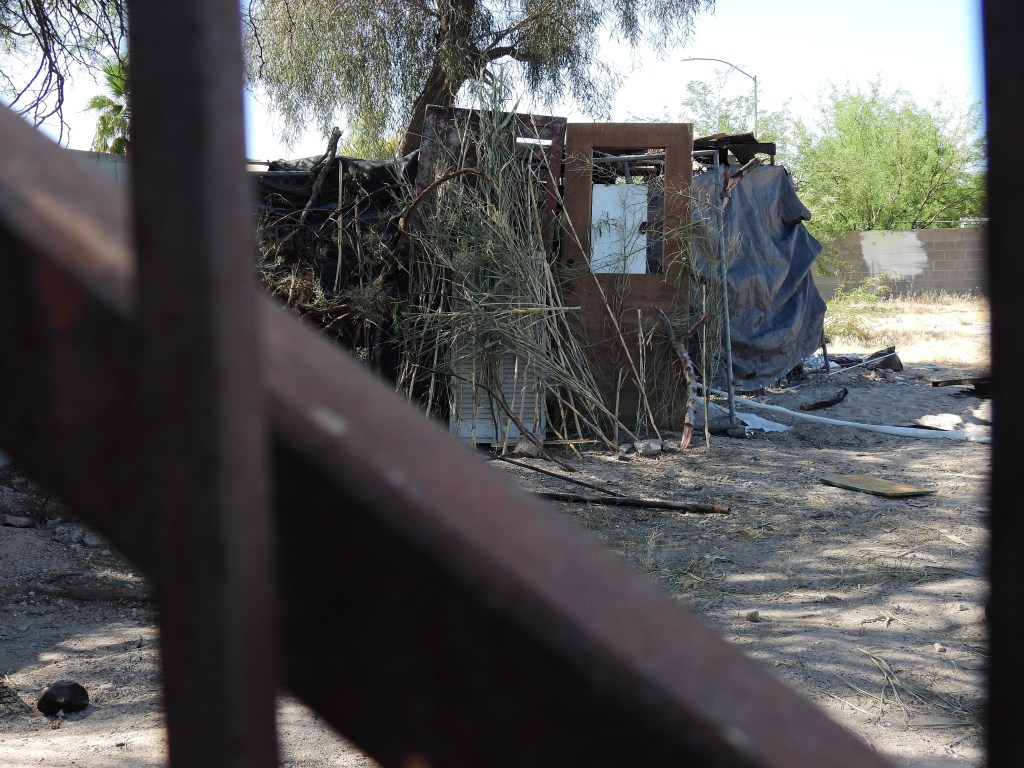
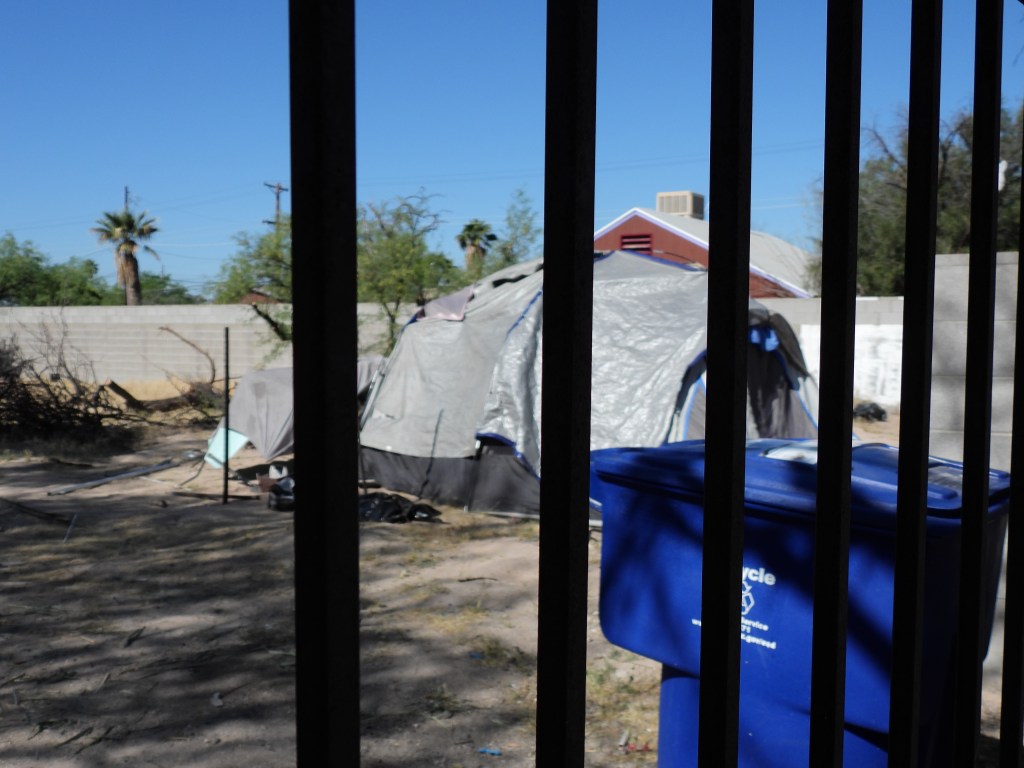
Many South Tucson homeless people, like Leonard, sleep on residential streets. Until now, all the thousands I had seen starting in the late 1970s lived on main thoroughfares. He and hundreds more sleep on narrow strips between sidewalks and curbs.
It is difficult to believe that most other residential areas would tolerate a floating homeless population as neighbors. South Tucson’s impecuniousness likely explains residents’ acceptance. “This is about the worst Tucson neighborhood,” Leonard says.
In 2022, the city of Tucson concluded that there were a little more than 2,000 homeless people.
This excerpt from Area Vibes, a data analytics company company, is illustrative:
The crime rate in South Tucson is 575.2% higher than the national average. These crimes fall into two primary categories: violence and property. Violent crimes include murder, rape, robbery, and assault, while property crimes involve theft, vehicle theft and burglary.
There were 109 reported violent crimes, equivalent to 2402 per 100,000 individuals, 549.7% higher than the national average. Additionally, there were 603 property crimes, amounting to 13291 per 100,000 residents, 580% higher than the U.S. average.
With a crime rate of 15,693 per 100,000 residents, South Tucson’s crime rate is 575.21% higher than the national average, leading to one of the highest overall crime rates in the nation.
South Tucson ranks among the most dangerous cities in the United States, bearing a violent crime rate of 2402 per 100,000 people, positioning it within the lowest 10% of all U.S. cities reporting crime statistics. The odds of falling victim to violent crime in South Tucson stand at 1 in every 42 residents, emphasizing the pressing need for enhanced safety measures and community engagement to address this significant concern.
While murder rates in the United States have generally declined since 1990, recent years have seen an uptick. South Tucson stands out with one of the nation’s highest murder rates among cities reporting crime data. In South Tucson, a total of two murders were reported, equating to 44 murders per 100,000 residents.
South Tucson reports one of the nation’s highest property crime rates, with 13291 incidents per 100,000 people, positioning it among the worst 10% of American cities reporting crime. This statistic translates to a 1 in 8 chance of falling victim to property crime in South Tucson, significantly surpassing the national average.
With 38 vehicle thefts last year, South Tucson has one of the most stolen cars in the country at 838 per 100,000 people. This lands South Tucson in the bottom 10% of all cities that reported crime, and the chance of any vehicle being stolen is one in 120.
AreaVibes surveyed 37 residents in South Tucson to gauge the area’s safety. Based on the results, 27% of people answered that there was very little crime in South Tucson and felt comfortable walking alone at night. Another 73% of people responded that there was far too much crime, and they would be hesitant to walk the streets alone at night. Keep in mind that residents’ opinions may vary depending on which area they live in.
The South Tucson crime rate is 575% higher than the national average. Breaking that down daily translates into 1.95 crimes per day.
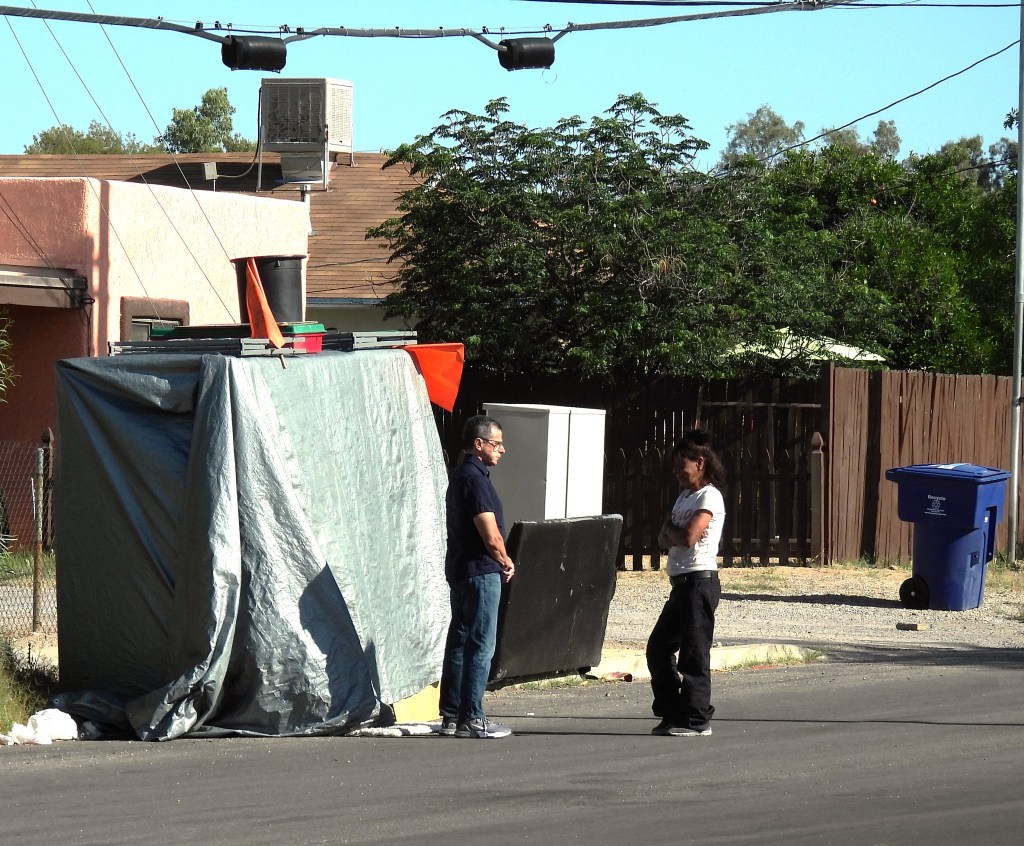
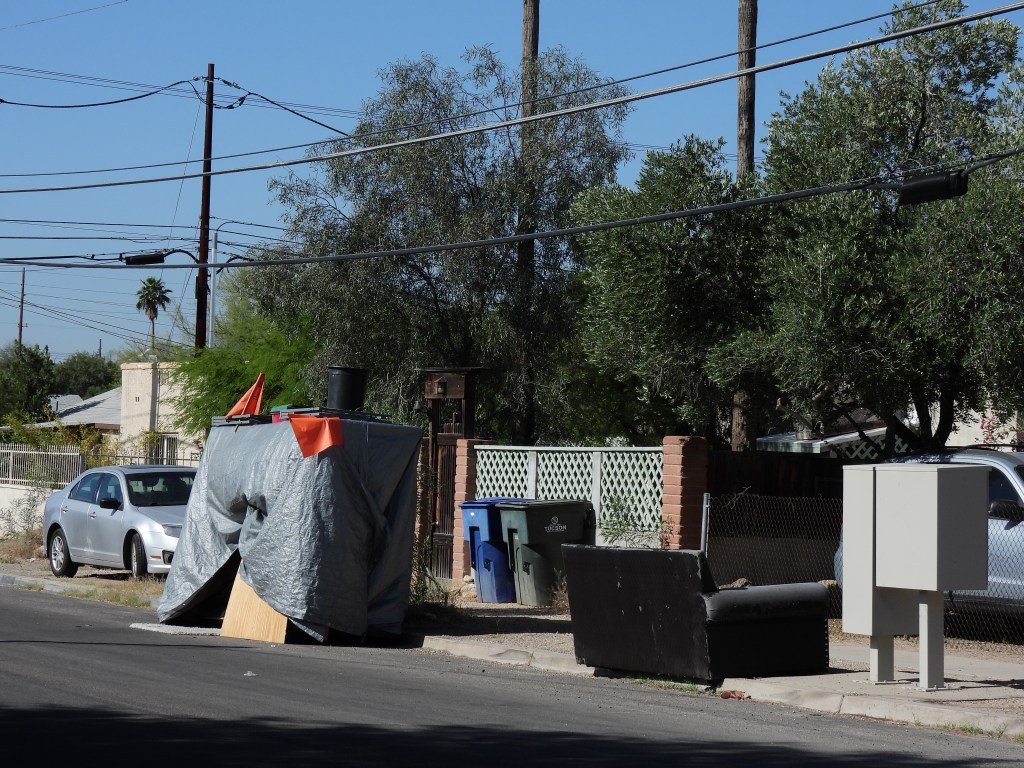
Jo-Jo, a tiny, bedraggled Mexican American woman, looks at me quizzically. I have just called her out from a jerry-built mobile shelter that measures about four feet by six feet. It is shrouded in sheets of non-translucent plastic and has a plywood floor.
Satisfied that it is okay to chat with me, Jo-Jo, perhaps 50 years old, says she had a job and lived in an apartment until five months ago. For reasons she prefers not to divulge, Jo-Jo, a male companion, and a dog inhabit the rolling shelter.
Squinting and shading her eyes from the morning sun, Jo-Jo notes she has adult children, who presumably could help her. “They don’t live around here,” she explains, as though that was reason enough not to assist her. I sense there is more to her story.
More than anything, Jo-Jo says she wants a real place to live. “I can’t get an apartment,” she says, rubbing her grimy neck,” without a job. Jo-Jo scratches out a living recycling metal and plastic and receives food stamps.
I remark that her shelter is innovative. “Yeah, it’s a place that gives a little shelter,” she grins. “We got to move often because neighbors complain about us being close to their houses. I understand that. It’s illegal to sleep out in the street,” she says.
Tucson laws, however, do not prohibit sleeping in the streets. People can sleep on sidewalks as long as they do not obstruct pedestrians.
Jo-Jo uses a public facility to wash up but is careful not to leave the shelter unguarded. “People have robbed me many times, she says. “They are homeless like me but bad. This is a dangerous place to live.”
 Ricardo Chavira Chicano